






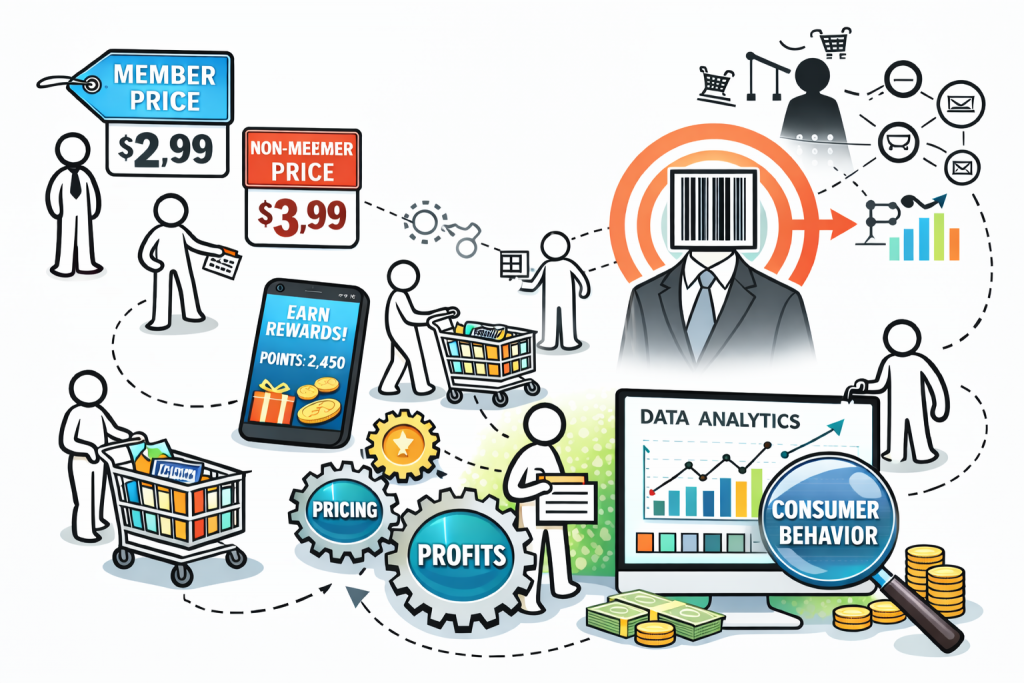
How “Free Rewards” Turn Your Purchases Into Data, Pricing Levers, and Behavioral Gravity
You’ve seen it everywhere:
- “Join for free and save today.”
- “Members get exclusive pricing.”
- “Earn points—get rewarded.”
- “Download the app for extra offers.”
It feels like a perk. It sounds like fairness. It markets like a gift.
But loyalty programs aren’t charity. They’re one of the most efficient consumer-engineering systems modern commerce has ever deployed—because they don’t just change what you buy. They change how you think, how you compare, how you return, and how you accept pricing.
And the big question—when members get rewards, is the non-member base paying higher prices?—has a real, nuanced answer:
Sometimes yes in practice. Sometimes not provably in the clean “they raised shelf prices by X%” way people imagine. But the system is absolutely designed so that “not playing” costs you, while “playing” funds the machine with your data and attention.
When the UK Competition & Markets Authority (CMA) examined grocery “loyalty pricing,” it reported very limited evidence of widespread, deliberate price inflation designed to fabricate fake savings. However, it also acknowledged that shifting between promotional structures can obscure what the “usual price” actually is.
(Source: CMA Executive Summary — https://assets.publishing.service.gov.uk/media/6749f28975bb645366b3a2a9/Executive_summary__2.pdf)
The CMA also publicly addressed consumer concerns about fairness and perception in loyalty pricing.
(Source: UK Government Statement — https://www.gov.uk/government/news/groceries-loyalty-prices-offer-genuine-savings-says-cma)
So let’s expose the science of it.
1) Loyalty programs aren’t “rewards.” They’re behavioral devices.
At their core, most loyalty programs run on three psychological levers:
A) Operant Conditioning: Buy → Get Something
Action (purchase) → reinforcement (points/perks) → increased future action.
The reward doesn’t need to be large. It needs to be reliable enough to build habit—and variable enough to feel like opportunity.
B) The Progress Effect
Points function as a visible progress meter. Once you’re partway toward a reward, abandoning it feels like waste.
Shopping becomes completion behavior.
C) Identity Lock-In
Gold. Elite. VIP. Member.
Status language converts transactions into belonging. Multi-tier loyalty systems are explicitly studied as segmentation and price discrimination mechanisms in academic research.
(Source: JSTOR Study on Multi-Tier Loyalty — https://www.jstor.org/stable/26180040)
2) The Economics: Loyalty Is a Pricing System Wearing a Friendly Hat
Loyalty programs monetize through structural mechanisms.
A) Price Discrimination
Member-only pricing, app-exclusive deals, and targeted coupons divide customers into behavioral segments and charge them differently based on predicted behavior.
Algorithm-driven pricing systems are increasingly studied in economic research.
(Source: NBER Working Paper on Automated Pricing — https://www.nber.org/system/files/working_papers/w32540/w32540.pdf)
B) Breakage
Large volumes of points expire unused. The “reward” is frequently an accounting promise never fully redeemed.
Generosity marketed. Liability minimized.
C) Float
App wallets and stored balances allow companies to receive funds now and fulfill obligations later—or never.
3) Do Non-Members Pay More?
The simplest honest answer:
Non-members are more likely to pay the highest observable price.
When UK regulators investigated whether grocery stores inflate non-member prices to exaggerate loyalty savings, Reuters reported that the watchdog found little evidence of systematic inflation for that purpose.
(Source: Reuters Coverage — https://www.reuters.com/world/uk/uk-watchdog-little-evidence-supermarkets-loyalty-prices-misleading-shoppers-2024-07-26/)
However, pricing presentation can make baseline prices difficult to interpret.
The “Two Prices” Reality
When shelves display:
Member Price
Non-Member Price
The non-member price becomes the penalty price.
In surveys cited during the CMA review, a significant percentage of consumers believed non-member prices were inflated and considered the practice unfair.
(Source: CMA Public Statement — https://www.gov.uk/government/news/groceries-loyalty-prices-offer-genuine-savings-says-cma)
4) The Modern Loyalty Program Is Also a Data Pipeline
Old loyalty: punch card.
New loyalty: identity + device + purchase history + timing + location + behavioral prediction.
The U.S. Federal Trade Commission has studied “surveillance pricing”—the use of personal data to influence individualized pricing structures.
(Source: FTC Surveillance Pricing Report — https://www.ftc.gov/news-events/news/press-releases/2025/01/ftc-surveillance-pricing-study-indicates-wide-range-personal-data-used-set-individualized-consumer)
Consumer Reports has documented how major retailers use loyalty data to construct detailed behavioral profiles.
(Source: Consumer Reports Investigation — https://www.consumerreports.org/media-room/press-releases/2025/05/consumer-reports-investigation-uncovers-krogers-widespread-data-collection-of-loyalty-program-members-to-create-secret-shopper-profiles/)
Even when prices are not personalized at the individual level, loyalty systems create the infrastructure that makes segmentation possible.
Identity linkage is the missing ingredient. Loyalty provides it.
5) Case Studies: Three Flavors of Loyalty Power
Coffee & App Ecosystems
Many large chains treat loyalty as a margin engine—driving app adoption, stored value behavior, and personalized nudges.
Grocery “Member Pricing”
Expanded loyalty pricing triggered regulatory review and public scrutiny in the UK.
(Source: Reuters Report — https://www.reuters.com/world/uk/uk-watchdog-little-evidence-supermarkets-loyalty-prices-misleading-shoppers-2024-07-26/)
Airline Loyalty as a Standalone Business
Airline loyalty programs increasingly generate substantial revenue through partnerships and credit card ecosystems.
(Source: The Guardian — Airline Loyalty Revenue — https://www.theguardian.com/business/2026/feb/26/qantas-half-year-profit)
6) The Hidden Mechanics Most Consumers Never Audit
Margin Steering
- Bonus points on high-markup goods
- Threshold spending incentives
- Bundle promotions
Algorithmic Calibration
Pricing engines learn where discounts influence behavior—and where they aren’t needed.
(Source: NBER Pricing Study — https://www.nber.org/system/files/working_papers/w32540/w32540.pdf)
Perceived Fairness Engineering
Research suggests algorithm-driven price discrimination may feel less objectionable than visible human discrimination—reducing backlash even when segmentation persists.
Automation reduces outrage.
7) The Share-Worthy Punch
Loyalty programs didn’t become universal because they’re generous.
They became universal because they can simultaneously:
- Increase retention
- Increase basket size
- Reduce promotional waste
- Create switching costs
- Generate measurable consumer data
- Enable surveillance-ready pricing systems
- Shift full price toward less engaged shoppers
The “reward” is often the smallest part of the value exchange.
The larger value lies in what the program learns about you—and what it trains you to accept.
Closing
A loyalty program is a consent form disguised as a coupon.
It trains you to identify yourself, to carry your behavior into a database, and to accept a world where the “real price” requires enrollment.
And once enrollment becomes the norm, the question quietly shifts from:
“Do you want rewards?”
to:
“Do you want to pay the penalty for staying anonymous?””