






If you find this article interesting, you should check out and find out more exposed facts about technology you SHOULD be aware of.

The Weight of Technology, Now available on Kindle and Paperback version on Amazon
Smart glasses used to be a sci-fi punchline. Now they’re on real faces in real bars, offices, sidewalks, classrooms, and living rooms.
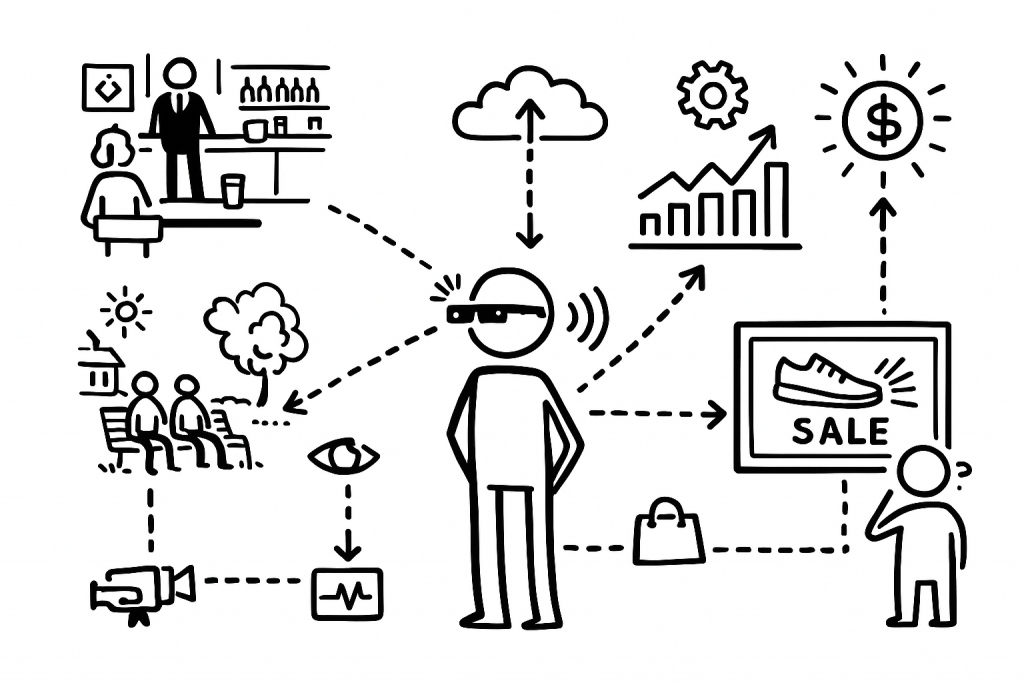
Meta has Ray-Ban smart glasses with cameras, microphones, speakers, and an AI assistant that can “see” what you see.Ray-Ban+1 Google Glass helped start the trend before being killed off (twice) after years of privacy backlash.TechTarget+1 New players are shipping AI glasses and even “camera-free” smart glasses that still listen through multiple microphones.The Verge Apple is rumored to be lining up its own Siri-powered glasses.ThreeMagazine
On the surface, these devices are sold as convenience: hands-free photos, navigation, AI in your ear, music without earbuds. Underneath, they’re always-on sensor platforms strapped to your face — and that has consequences for you, for your business, and for everyone around you.
This article breaks down how today’s smart glasses work, what data they collect, how that data can feed advertising and profiling, the business and residential risks, and what you can do to protect both your own privacy and the privacy of people who never agreed to be part of your data trail.
1. What counts as “smart glasses” today?
“Smart glasses” is a broad label. A few main categories:
1.1 Consumer social/AI glasses (Meta, etc.)
Ray-Ban Meta smart glasses (Meta)
Meta’s current Ray-Ban line (evolved from “Ray-Ban Stories”) bundles:
- Outward-facing cameras for photo and video
- A multi-microphone array
- Open-ear speakers
- Voice control (“Hey Meta”) and Meta AI features, including describing what the cameras see
- A companion app that syncs media and settingsRay-Ban+2Wikipedia+2
Mozilla’s Privacy Not Included review flagged these as “super creepy” because they can quietly record what you see and hear while pushing that data through Meta’s ecosystem.Mozilla Foundation+1
Other consumer devices (Snap Spectacles, various AI glasses from smaller brands, and new players like Even Realities) sit in this same general space: cameras and/or microphones + connectivity + companion app + some AI or overlay features.The Verge+1
1.2 AR / productivity glasses and headsets
Things like Microsoft HoloLens, Apple Vision Pro, and research-grade eye-tracking glasses (Tobii Pro) are heavier-duty. They tend to include:
- Full AR displays or immersive screens
- Eye tracking (where your eyes are looking)
- Hand/gesture tracking
- Sometimes integration with other biometric sensors like heart rate or EEG via other wearablestobii.com+2mBrainTrain+2
These are often used in research, training, industrial, or medical settings — but they show where the consumer market is headed.
1.3 Legacy: Google Glass
Google Glass was one of the earliest mainstream experiments: eyeglasses with a small display, camera, microphone, and touch controls along the frame. It was eventually discontinued in 2023, after years of pushback over people being recorded without consent and bans in bars, casinos, and other venues.TechTarget+1
Even though Glass is gone, the privacy fights it triggered are highly relevant to today’s devices.
2. What makes smart glasses “smart”?
Under the stylish frames, you usually get four building blocks:
- Sensors
- Cameras (photos, video, sometimes depth)
- Microphones (often multiple mics for beamforming/noise reduction)
- Motion sensors (accelerometer, gyroscope) to know head movement
- Sometimes proximity, ambient light, or temperature sensors
- In research setups, eye tracking and other biometrics (heart rate, EEG, GSR) via additional wearablesPMC+2tobii.com+2
- Compute
- An onboard processor handles basic tasks: capturing media, running wake-word detection (“Hey Meta”), some local AI tasks
- Heavier AI — image recognition, translation, object identification — typically runs on servers in the cloud or on a paired phone
- Connectivity
- Bluetooth to connect to your phone
- Wi-Fi (directly or via the phone) for uploads, streaming, and cloud AI calls
- Interfaces
- Tiny displays or HUDs (heads-up displays), or full AR waveguides in more advanced modelsBrandXR+1
- Voice assistants (Meta AI, Google Assistant in older devices, future Siri variants)
- Touch surfaces on the frame or side
- Sometimes eye-tracking as an input method (look at object + pinch gesture, etc.)tobii.com+1
Put together, that gives you a wearable that can:
- Show you turn-by-turn directions in your field of view
- Record video at eye level with a tap or voice command
- Translate a street sign or menu by looking at it
- Describe what the camera sees using an AI model (Meta’s latest glasses do this)Meta+1
That’s the convenience layer. The more interesting (and dangerous) layer is what happens when all that sensing, all that context, and all that history get funneled into data pipelines built to monetize attention.
3. What data do smart glasses actually collect?
Think in layers of data:
3.1 Primary captured content
- Photos and videos from the outward-facing cameras
- Ambient audio from the microphones – not just your voice, but everyone nearby
With Ray-Ban Meta glasses, that media is synced via a companion app and can be shared directly to major social platforms (Meta’s and others).Mozilla Foundation+1
3.2 Metadata and telemetry
Almost everything you do on a modern device generates meta-data exhaust:
- Timestamps, locations, Wi-Fi/Bluetooth environment
- Which features you use (recording, calls, AI queries, music) and how often
- Battery levels, error logs, crash reports
- “Performance” or “analytics” metrics: how long you wear them, when you interact, what you interact with
Mozilla’s review of Ray-Ban smart glasses notes that Meta can collect device metadata, app usage, and technical information in addition to the obvious photos/videos/audio.Mozilla Foundation+1
3.3 Derived and inferred data
This is where marketing and profiling really kick in. From what you capture, systems can infer:
- Where you tend to go (commute, favorite bar, gym, grocery store)
- What brands and logos are frequently in your field of view
- Who you hang out with (faces that recur in your photos/videos)
- What media you watch (TV shows, YouTube on a TV screen, billboards)
- Your interests (sports stadiums, bookstores, fast food chains, luxury retailers, political rallies)
Even if the vendor says they “anonymize” or aggregate this data, research shows that patterns in behavior (especially combined with location) are notoriously re-identifiable.
3.4 Biometric and quasi-biometric data
Right now, most consumer smart glasses do not include full-blown eye tracking or heart-rate sensors. But research and higher-end AR/VR gear show where this is going:
- Eye tracking glasses (e.g., Tobii Pro Glasses 3) measure:
- Gaze direction (what you look at)
- Fixations (how long you focus on something)
- Saccades (rapid eye movements)
- Pupil size and blink ratetobii.com+2Frontiers+2
- Biometric wearables integrated with these setups capture:
- Heart rate (HR) and heart rate variability (HRV)
- Galvanic skin response (GSR) for arousal/stress
- EEG (brainwave patterns) via separate headsetsmBrainTrain+2PMC+2
Studies show you can infer stress, anxiety, attention, and even personality-linked traits from these signals.PMC+2ScienceDirect+2
So even when smart glasses don’t directly include all of these sensors yet, the ecosystem (headsets, research tools, AI pipelines) is moving toward glasses that know:
- What you looked at
- What you really noticed
- How you emotionally responded
That’s a biometric marketer’s dream — and a privacy nightmare.
4. From data to dollars: smart glasses and advertising
Right now, most consumer smart glasses are still focused on capture + social sharing + light AI. But the advertising world is already working out how to turn them into billboards on your face.
4.1 Context-aware ads in your field of view
Industry pieces describe smart glasses and AR as the “next frontier” where:
- Ads become spatial overlays on the real world
- Brands appear near physical products you’re looking at
- Stats, promos, and reviews float next to items in a store window or at a stadiumBrandXR+3Forbes+3The Next Dimension Book+3
Imagine:
- You look at a sneaker display → an overlay offers a discount, shows reviews, and nudges you to a specific model.
- You stare at a craft beer tap handle → an AR badge pops up recommending a brand your demographic responds to most.
- You watch a TV show in your living room → subtle prompts in your glasses suggest related products or content.
This isn’t sci-fi; it’s the logical (and already discussed) direction of AR advertising, driven by AI models that use location, visual scene understanding, and gaze.The Next Dimension Book+2BrandXR+2
4.2 Can glasses “see or hear a room” and tailor ads?
Technically: yes.
If a pair of glasses has:
- A camera capable of running object recognition (already a feature in Meta’s AI glasses, which can identify objects and read text in view)Meta+1
- Microphones that can hear ambient TV audio, music, or spoken brand names
- Location data and a history of what you engage with
…then the system can absolutely derive context from your surroundings and use it to decide which content, prompts, or ads to show now or later.
We’ve seen similar tech in other domains:
- Smart TVs and mobile apps that use audio fingerprinting to recognize shows/ads you’re watching
- Eye-tracking studies used to optimize ad placement based on what people actually look atiMotions+1
So even if you’re not seeing pop-up AR ads in your glasses today, the data pipeline for context-aware and gaze-aware marketing is already being built and tested.
4.3 Programming priority: who gets to steer your attention?
When you wear smart glasses for hours, your “feed” is no longer just a screen you can put down. Notifications, suggestions, and overlays appear in your visual field. That raises questions:
- Who decides which notifications interrupt reality?
- Which apps are allowed to overlay content where you’re looking?
- Do paying advertisers get “priority” in that field?
Articles on next-gen smart glasses advertising talk explicitly about “presence as the ad format” — being there at exactly the right moment in your view.The Next Dimension Book+2Forbes+2
Once your glasses become a primary interface, “programming priority” is just another knob algorithms can turn, often aligned with business incentives rather than your wellbeing.
5. Risks in business environments
Bringing camera- and mic-equipped glasses into workplaces is a completely different threat profile.
5.1 Confidentiality, trade secrets, and compliance
Risks include:
- Accidental capture of whiteboards, prototypes, documents, login screens
- Intentional capture for industrial espionage
- Recording sensitive conversations (HR meetings, legal discussions, medical consults, board meetings)
AR privacy research points out that smart glasses can collect “sensitive user data — such as biometrics and bystander face images — in a continuous, ambient way”, raising major context-specific risks.Pet Symposium+1
For regulated industries (healthcare, finance, law, government), having employees walking around with always-on cameras/mics tied to third-party cloud services is a compliance nightmare:
- HIPAA (health data)
- GDPR / CCPA (personal and biometric data)
- Trade secret and confidentiality agreements
And here’s the kicker: if an employee’s glasses capture customer faces, voices, or screens, the company may have no direct control over that data once it’s ingested into the vendor’s ecosystem for “service improvement” or AI training.Cybersecurity Advisors Network+1
5.2 Surveillance culture and employee monitoring
Smart glasses can also turn inwards:
- Managers could use them to quietly record staff
- Retail workers could be told to wear them for “training and analytics”
- Warehouses and call centers could analyze where workers look, how fast they move, what they do with their hands
Research already shows that eye tracking + biometrics can infer attention, workload, and stress.PMC+2ScienceDirect+2
Combine that with AI, and suddenly you’re ranking employees on “focus”, “engagement”, or “customer smile time” based on signals they never consciously chose to share.
6. Risks in homes and everyday life
At home, wearing smart glasses can feel like just another gadget. But it changes the default state of your space.
6.1 Always-on witnesses
With smart glasses:
- Children, guests, and partners may be recorded without realizing it
- Sensitive moments (arguments, intimate moments, medical care) can end up as audio or video on a corporate server
- If you stream or upload content regularly, it’s easy to accidentally include bystanders or private details in the background
Critics have called Ray-Ban Meta glasses “spy glasses” because the cameras are small, well hidden, and easy to trigger, and the LED recording indicator can be subtle or potentially circumvented.Wikipedia+2Mozilla Foundation+2
6.2 Stalking and abuse
Any device that can:
- Track locations
- Record audio or video discreetly
- Pipe that data to the cloud or share it remotely
…can be misused by abusive partners, stalkers, or harassers:
- Secretly filming someone at home or in public
- Logging visits to certain places (shelters, clinics, friends’ houses)
- Collecting compromising material used for coercion
Smart glasses add a layer of plausible deniability: “I was just wearing my glasses.”
6.3 Bystander rights (or lack thereof)
AR privacy researchers point out a disturbing reality: when your data is captured by someone else’s device, you typically have no visibility, no access, and no ability to delete it.Cybersecurity Advisors Network+1
You didn’t agree to the Terms of Service. You can’t see the privacy dashboard. But your face, voice, and environment may still be swept up, processed, and stored.
That’s the “invisible consent” problem: the people who are most affected by the sensors often have the least control over them.
7. Biometric futures: when glasses know how you feel
We need to talk about the next layer: cognitive and emotional profiling.
Research shows that combining eye tracking, heart rate, and other signals can predict:
- Emotional states like stress, anxiety, or excitement
- Cognitive load (how hard your brain is working)
- Traits and preferences at a surprisingly personal levelPMC+2ScienceDirect+2
Smart glasses are a natural platform for this because:
- They sit close to your eyes
- They can pair with watches, rings, and other biometrics (heart rate, HRV, GSR)
- They already need to understand your environment to function
Academic papers already treat eye-tracking features like pupil size, fixation patterns, and saccades as biometric identifiers — unique enough to help distinguish individuals.Frontiers+1
Tie that to AR advertising concepts like “personalized, context-aware experiences based on visual attention patterns,” and you can see the path where:BrandXR+1
- Ads are not just tailored to what you look at
- They’re tuned to how strongly you react — and optimized over time to hit your psychological soft spots
That’s not here at scale yet in consumer smart glasses, but the building blocks are.
8. Vulnerabilities and attack surface
Even if you trust the vendor (big if), you still have to worry about the rest of the threat landscape.
8.1 Device and app vulnerabilities
Smart glasses add:
- Another Bluetooth-connected device that can potentially be attacked or spoofed
- A companion app with deep permissions on your phone (storage, camera roll, microphone, location)
- Firmware that may be slow to receive security updates
If attackers compromise the app, the glasses, or the account, they could:
- Turn them into remote eyes and ears
- Steal your recorded media and contacts
- Inject malicious prompts or overlays
Given how frequently IoT devices have weak security by default, it’s reasonable to treat smart glasses as a high-risk node.
8.2 Cloud breaches and data repurposing
Even with strong encryption in transit, most smart glasses rely on:
- Cloud storage for photos/video backups
- Cloud AI services to process images and audio
- Cloud analytics for “product improvement”
AR privacy research and cybersecurity commentary emphasize that once data is in these systems, it can be:
- Used to train AI models
- Repurposed for new features or business lines
- Shared with partners or law enforcement, often under broad policy languagePet Symposium+2Cybersecurity Advisors Network+2
A breach, subpoena, or policy change can suddenly expose years of intimate physical-world context — not just browser history, but real rooms, real faces, real conversations.
8.3 Indicators that can be bypassed
Vendors often point to recording LED lights or sounds as privacy safeguards. But critics have long noted:
- LEDs can be tiny and easy to miss, especially in bright light or at a distance
- A software or hardware hack could disable or spoof them
- Bystanders can’t realistically check firmware version and configuration before deciding whether they’re OK being recordedWikipedia+2Reddit+2
So indicators are better than nothing — but far from a robust solution.
9. How to protect your privacy (and everyone else’s)
You can’t fix the entire ecosystem alone, but you can reduce your personal risk and avoid becoming an unwilling surveillance node.
9.1 If you’re considering buying or using smart glasses
- Read the privacy reviews, not just the product page.
- Resources like Mozilla’s Privacy Not Included often give more candid assessments of how much data a device collects and how it’s used.Mozilla Foundation+2Wikipedia+2
- Prefer models with fewer sensors when possible.
- Do you actually need outward-facing cameras?
- Some newer products deliberately ship without cameras to reduce bystander anxiety while still offering displays and microphones.The Verge
- Harden your account and device.
- Turn on 2FA for the account tied to the glasses
- Use a strong, unique password
- Keep firmware and the companion app updated
- Limit cloud exposure where you can.
- Turn off automatic cloud backup if possible
- Regularly delete old media from both the glasses and the app
- Opt out of “product improvement” and “analytics” programs where settings allow
- Disable or restrict voice assistant history.
- Many assistants let you delete voice logs or turn off saving audio by default
- Do that. Your future self will thank you.
- Use them consciously, not ambiently.
- Treat recording like holding up a phone: do it intentionally, not as a default state
- Take them off in bathrooms, bedrooms, locker rooms, clinics, therapy sessions, and other obviously sensitive spaces
9.2 If you’re a business owner or leader
- Write a clear policy on smart glasses and wearables.
- Where they’re allowed (public showroom, warehouse aisles)
- Where they’re banned (conference rooms, HR meetings, any area with customer data on screens)
- How they must be configured if allowed (no recording, no streaming, no audio capture)
- Update your confidentiality and security training.
- Teach staff that smart glasses are recording-capable computers, not just fashion accessories
- Include scenarios: whiteboards, prototypes, customer interactions, payment terminals
- Consider technical controls.
- Require employees to use company-managed devices and accounts when necessary
- Use mobile device management (MDM) or enterprise tools to enforce restrictions where supported
- Add signage in sensitive areas: “No cameras or smart glasses beyond this point”
- Think about customers and bystanders.
- If staff interact with the public while wearing smart glasses, make that transparent and limit recording features
- Avoid turning your employees into involuntary data collectors for third-party platforms
9.3 Protecting bystander privacy (the “others” in the frame)
If you wear smart glasses:
- Tell people when you’re recording.
A simple “I’m recording, is that OK?” goes a long way. - Honor a “no.”
If someone doesn’t want to be recorded, stop or remove them from the frame. - Avoid filming kids without explicit parental consent.
Even Meta’s own campaigns urge owners to be careful about minors.About Facebook - Don’t record in obviously intimate or vulnerable contexts.
This isn’t just about law — it’s about basic respect.
If someone else is wearing them around you:
- It’s reasonable to ask, “Are those recording right now?”
- In your own home or business, you can set boundaries:
“We don’t allow camera-equipped wearables in here; would you mind putting those away?”
10. Where we go from here
Smart glasses compress a lot of our ongoing tech-privacy story into one object:
- A stylish accessory that doubles as an always-on sensor rig
- A convenience layer powered by an attention-harvesting business model
- A device you control — strapped to a platform you mostly don’t
The technology will keep improving. Cameras will get smaller. AI will get better at understanding scenes, emotions, and intent. Biometric inference will move from research labs into commercial products.
The question isn’t “Will smart glasses exist?” — they already do.
The real questions are:
- Who gets to decide what they see, store, and share?
- Who profits from what your eyes and ears pick up?
- How do we protect people who never chose to be part of this system in the first place?
On jeremyabram.net, I’d sum it up like this:
Smart glasses are not just “your” device. They are a networked sensor for the environment, powered by AI and monetized through attention. If we treat them like just another pair of sunglasses, we’ll sleepwalk into a world where the physical spaces around us are quietly recorded, analyzed, and optimized for someone else’s bottom line.
Use them if you want. Just don’t use them blindly.
If you find this article interesting, you should check out and find out more exposed facts about technology you SHOULD be aware of.
The Weight of Technology, Now available on Kindle and Paperback version on Amazon