






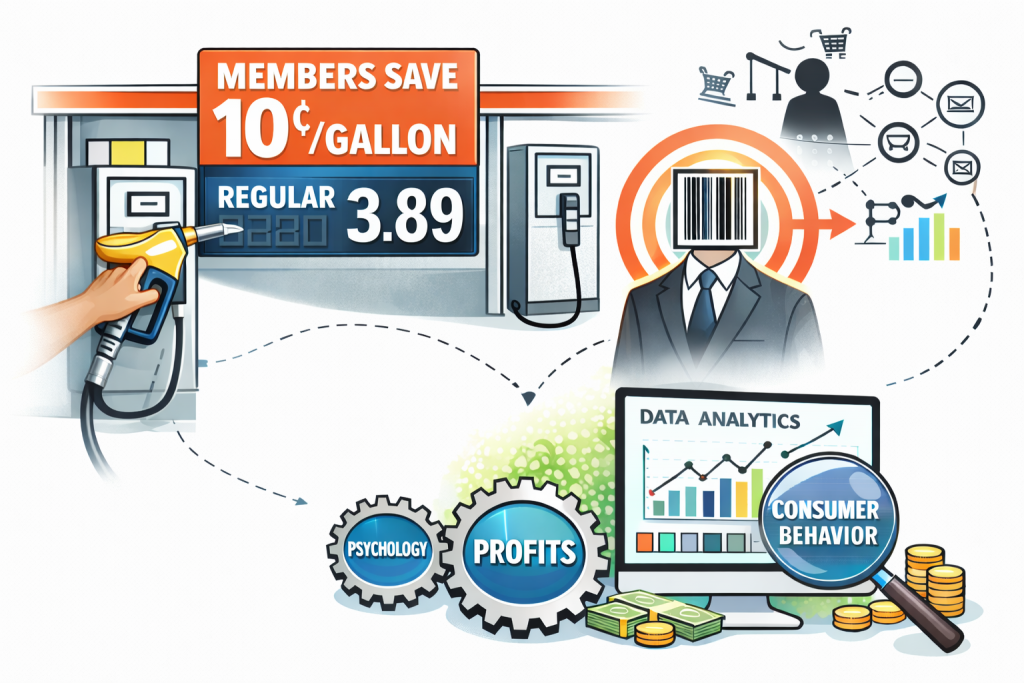
The Truth About Gas Rewards Programs – Exposed.
How Fuel Rewards Programs Reshape Your Wallet, Your Choices, and Your Data
Gasoline is one commodity almost every adult purchases — often more than once per week, and often without comparison shopping. That recurring necessity makes fuel one of the most emotionally charged, price-visible, and behaviorally leveraged products in the entire retail ecosystem. And enterprising marketers have turned that emotionality into a sophisticated loyalty mechanism.
Fuel rewards programs are now everywhere: chains offer cents-off gasoline, grocery stores link purchases to fuel discounts, and convenience stores build tiered perks that promise savings. But beneath the surface, these programs are carefully engineered to shape your behavior, perception of price, and willingness to share personal data — all while keeping you loyal to one brand or station over another.
Let’s dig in.
1. What Are Fuel Rewards Programs — Really?
Unlike traditional punch-card punch-once-and-get-one-free models, fuel loyalty systems blend various elements:
🛞 Immediate cents-off discounts
Programs like Fuel Rewards Network and Shell Fuel Rewards offer direct per-gallon discounts when you sign up and reach certain tiers. These might start as low as 3–5¢/gallon and ramp up to 10¢ or more for loyal behavior.
Source:
https://www.fuelrewards.com/how
https://www.shell.us/rewards-and-savings/fuel-rewards.html
🛞 Points-based earning
Retailers such as Kroger Fuel Points Program give you fuel points based on grocery or store spending (e.g., 1 point per dollar), which translate into fuel discounts — often 10¢ off per gallon for every 100 points earned.
Source:
https://www.kroger.com/d/fuel-points-program
🛞 Earn from partners
Some fuel programs let you earn more discounts by dining, shopping online, or using linked credit cards with participating retailers.
Source:
https://www.fuelrewards.com/how
🛞 Tiered status and exclusives
Rather than a flat “stamp card,” many fuel programs offer tiered membership where benefits increase the more you engage.
Source:
https://www.shell.us/rewards-and-savings/fuel-rewards.html
2. The Unique Economics of Fuel Rewards
Fuel rewards differ from most loyalty systems because gasoline itself is:
📍 Highly price-visible — every driver sees the per-gallon price displayed publicly.
📍 Emotionally salient — fuel cost hits a weekly budget directly.
📍 Repetitive — most drivers fill up many times per month.
This combination creates a powerful psychological lever: even small discounts feel meaningful because they’re tied to something we check publicly and often.
That perception of “big savings” — even as the discount may be only a few cents per gallon — makes consumers more willing to enroll and engage.
Source:
https://yougov.com/en-us/articles/52811-how-fuel-loyalty-programs-fare-among-american-drivers
3. How Fuel Rewards Programs Influence Behavior
🧠 Push Everyone to Enroll
Fuel discounts nearly always require a membership — typically free to join but linked to an identity (phone number, account, email). Once you join, the “full” posted price starts to feel like a penalty. That’s pricing by consent.
This dynamic turns:
“Do I want rewards?”
into
“Can I afford not to sign up?”
That shift is powerful in gasoline markets, because skipping a station with rewards often feels like literally leaving money on the table. ✂️
🛍 Encourage Higher Spend
Many programs link fuel savings to other purchases:
Grocery points convert into fuel discounts.
Source:
https://www.kroger.com/d/fuel-points-program
In-store convenience purchases at fuel stations earn points.
Source:
https://goftx.com/blog/fuel-linked-loyalty-cents-off-instore-rewards-digital-offers/
Dining or partner purchases add to your fuel savings.
Source:
https://www.fuelrewards.com/how
The promise of discounted fuel — sometimes 10¢/gallon or more — psychologically justifies spending more on food, drink, snacks, or other items you might otherwise bypass.
In essence:
“I saved at the pump, so that latte was worth buying.”
— a retail behavioral anchor.
📈 Drive Repeat Traffic
Gas stations compete fiercely on price. Loyalty programs help them shift the competition away from immediate price lines and toward repeat behavior. Customers who accumulate points and redeem discounts come back again and again — often without checking competitors’ real prices.
Source:
https://petrolgroup.pro/en/loyalty-programs-for-gas-stations/
This converts unpredictable gasoline purchases into sticky customer routines, which translates into long-term revenue and easier upselling in station convenience stores.
4. Why Fuel Rewards Can Be More Than Just Savings
Fuel loyalty isn’t just about cents per gallon. Many programs:
Collect granular data on where, when, and how often you fill up or shop.
Link to mobile apps that track behavior across purchases and locations.
Source:
https://www.voucherify.io/blog/challenges-and-examples-of-fuel-retail-loyalty-programs
Push personalized offers based on your patterns.
This turns gasoline stations into micro-data aggregators, layering behavioral, locational, and consumption information into user profiles.
Here’s why that matters:
👉 Fuel prices might appear simple and local, but fuel behavior can help retailers predict shopping patterns, peak visit times, potential cross-buy opportunities, and overall consumer stickiness — far beyond the pump.
5. Does Everyone Benefit Equally?
Fuel rewards perceived as “free money” often carry subtle asymmetries.
⚖️ Members vs. Non-Members
Signing up gives individuals access to lower shown prices — typically meaning non-members pay higher posted fuel prices. Even if the market rate hasn’t changed, the displayed “discount” creates a perception that:
“Non-members are paying more purely because they didn’t consent.”
A classic penalty pricing effect.
This is particularly potent for commodities like fuel, where price visibility is public and frequent.
💰 The Myth of “Big Savings”
Reductions like 3¢–10¢ per gallon sound large in contexts where gas costs $3–$4/gal, but:
Unless you refuel often, the total monthly savings can be modest.
Source:
https://www.thepennyhoarder.com/save-money/fuel-rewards-programs/
Many points programs require significant non-fuel spend to unlock the most meaningful discounts.
Source:
https://www.kroger.com/d/fuel-points-program
Points expire or don’t stack easily unless you are a very consistent shopper.
Source:
https://www.kroger.com/o/fuel/faqs
This echoes what critics of retail loyalty programs have long warned: the perception of savings often far outweighs the actual economics for many participants.
6. Partnerships and Cross-Brand Levers
Gas stations increasingly partner with grocery chains, restaurants, airlines, and credit cards to expand fuel reward earning opportunities.
Source:
https://www.fuelrewards.com/how
For example:
Dine at a participating restaurant and earn cents off per gallon.
Shop at a grocery, earn fuel points redeemable at a partner station.
Use a co-branded credit card and stack points with fuel discounts.
Source:
https://thepointsguy.com/loyalty-programs/fuel-loyalty-programs/
These networks expand the retail footprint of fuel rewards beyond the pump and blur the line between fuel purchases and general consumer spend — deepening behavioral embedding.
7. Data and Behavioral Profiling at the Pump
Unlike traditional grocery loyalty cards, gasoline transactions are often:
Repeated frequently
Linked to location data
Connected to broader digital profiles (apps, credit cards, payment methods)
That makes fuel programs especially potent for building predictive profiles on consumer mobility and broader spending habits.
And because fuel is an essential, recurring purchase, your participation reveals both routine and deviation — offering insights into commute patterns, travel frequency, preferred stations, peak shopping windows, and cross-shopping behavior.
Some studies show that fuel rewards have become so widespread that approximately two-thirds of American drivers belong to at least one program.
Source:
https://yougov.com/en-us/articles/52811-how-fuel-loyalty-programs-fare-among-american-drivers
8. The Hidden Behavioral Contract
Most consumers think:
“I just get discounted gas. They benefit from repeat business.”
But the unconscious bargain is deeper:
You trade your consumer data, mobility patterns, and spending habits for incremental fuel savings.
Many drivers never explicitly consider how joining a program:
Changes their station selection behavior
Encourages loyalty even when competitors are cheaper
Reinforces brand recognition and psychological attachment
Brings them into digital ecosystems that monetize beyond fuel
That’s behavioral design at scale.
9. The Real Cost of Fuel Rewards
The true cost of fuel rewards is not just what you save — it’s what you:
Stop noticing (competitor prices)
Spend extra on other purchases
Agree to share with data platforms
Normalize as the default “price” of filling up
That’s the power — and danger — of commoditized loyalty systems.
10. Summary: One More Than a Discount — A System
Fuel rewards are not just:
discounts on gasoline.
They are:
Behavior-shaping systems
Data acquisition engines
Perceived fairness mechanisms
Repeat-traffic drivers
Competitive price anchors
And because fuel is such a universal, essential purchase, these systems operate not just at the level of occasional savings — but at the psychological core of how consumers make everyday decisions.