






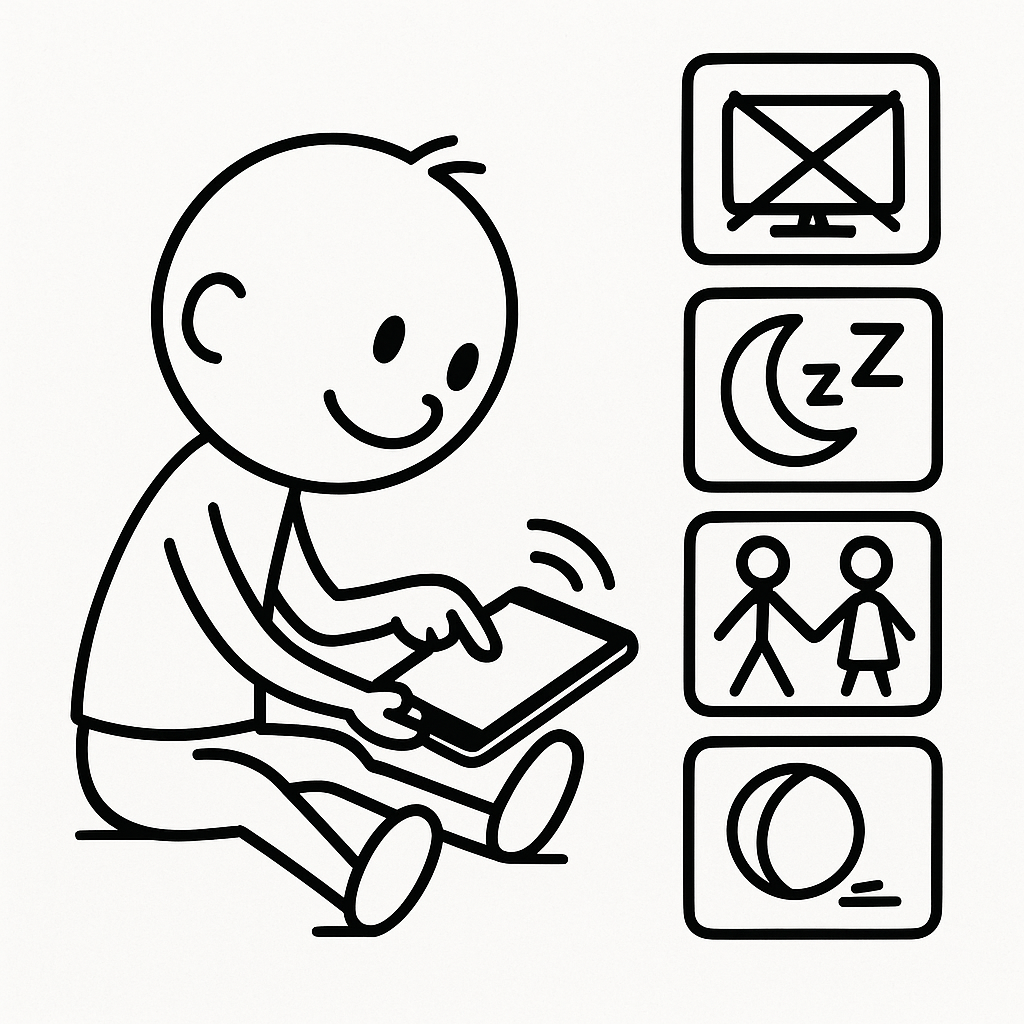
Parents aren’t imagining it: screens don’t just occupy children — they shape them. The modern screen isn’t a TV on the wall anymore. It’s a handheld, interactive, always-available dopamine slot machine with infinite novelty, frictionless swiping, autoplay, and persuasive design baked in.
This article breaks down what research and major health organizations say about screen time by age, what “swiping” changes (attention, self-regulation, sleep, language, social development), and practical ways to prevent “screen creep” from quietly replacing play, sleep, and real-world learning.
Why screens hit kids differently than adults
Children’s brains are under construction. In early childhood especially, development depends on:
- Back-and-forth interaction (language, social cues, emotional regulation)
- Sensorimotor play (fine motor skills, balance, coordination)
- Boredom and self-directed play (creativity, persistence, problem-solving)
- Sleep (memory consolidation, mood regulation, attention)
Screens can support learning in specific contexts, but the biggest consistent risk isn’t “screens are evil.” It’s that screens crowd out the ingredients development needs most.
The American Academy of Pediatrics (AAP) emphasizes there is no single “safe hours” number that fits all children; instead, families should evaluate the child, the content, and what screen time is displacing. AAP+1
The “swipe effect”: why interactive screens are not the same as TV
Touchscreens introduced something new: rapid reward loops.
Swiping, tapping, scrolling, shorts/reels, and many kid-focused apps are designed around:
- Instant feedback (sound, animations, points)
- Variable rewards (sometimes funny, sometimes surprising, sometimes “better”)
- Autoplay / endless feeds (no natural stopping point)
- Low-effort novelty (new stimulus without persistence or practice)
For a developing brain, this can train expectations like:
- “If I’m even slightly bored, something new should appear instantly.”
- “If something is hard, I should switch — not push through.”
- “I can self-soothe by consuming stimulation.”
That doesn’t doom a child. But it does mean the default environment matters. If the easiest comfort and entertainment is always a swipe away, real-world skills (patience, frustration tolerance, sustained attention) may get fewer reps.
Research in preschool-aged children is mixed and nuanced: some evidence links higher touchscreen use with weaker executive function outcomes, but results vary depending on how screens are used (passive video vs active/creative use, co-use with adults, content quality, and time replacing sleep/play). frontiersin.org
What screens can affect (by domain)
1) Language development and learning
Young children learn language best through live interaction: eye contact, turn-taking, pointing, responding, and shared attention.
Systematic reviews have found associations between screen time and language/executive function outcomes in early childhood — with a recurring theme: more screen time (especially passive or unsupervised) is more likely to correlate with poorer outcomes, while high-quality, interactive, adult-supported use can reduce harms and sometimes support specific skills. PLOS+2PMC+2
Real-world example:
- A toddler watching “educational” videos alone may hear lots of words, but gets fewer chances to practice words with a responsive human.
- The same video watched with a caregiver (“What is that? Can you point to it? What color is it?”) becomes more like a conversation than a broadcast.
2) Attention and self-regulation
Short-form video and fast-paced apps can condition the brain toward:
- frequent switching
- reduced tolerance for boredom
- seeking constant novelty
This shows up as “my child can’t focus” — but sometimes it’s not a permanent attention problem; it’s attention trained for a different environment.
3) Sleep (the most consistent screen link)
Across studies and expert consensus, screen use is strongly linked with worse sleep in children and adolescents, especially when used near bedtime. Mechanisms include:
- time displacement (staying up later)
- psychological stimulation (exciting content)
- light exposure affecting circadian rhythms
A 2024 consensus panel review concluded that, in general, screen use impairs sleep health among children and adolescents, with bedtime use being especially problematic. Sleep Health Journal+1
Translation: if you fix only one thing, fix screens before bed.
4) Vision and eye strain
Prolonged near work and screens are associated with eye strain and may contribute to myopia risk patterns in kids (alongside other factors like less outdoor time). (If you want, I can do a dedicated JeremyAbram.net-style deep dive on myopia + devices.)
Age-by-age guidance: when to introduce screens?
There’s no perfect “magic birthday,” but major guidelines converge on a simple principle:
The younger the child, the more screens should be limited and co-used with an adult.
Under 18 months
AAP recommends minimizing or eliminating media exposure other than video chatting. HealthyChildren.org+1
18–24 months
If you introduce screens, focus on high-quality content and use it together (co-viewing/co-playing). AACAP+1
Ages 2–5
WHO guidance for under-5s recommends that sedentary screen time for 2-year-olds be no more than 1 hour/day (less is better), and for 1-year-olds, sedentary screen time is not recommended. World Health Organization+1
Other pediatric guidance commonly suggests around 1 hour/day of high-quality use for preschoolers as a practical ceiling. AACAP
Ages 6+
AAP emphasizes building healthy habits and boundaries rather than a universal hourly number, focusing on whether screens crowd out sleep, physical activity, and offline relationships. AAP+1
The biggest risk isn’t “screens.” It’s what screens replace.
Ask these three questions:
- What is my child not doing because of screens?
Outdoor play, reading with a parent, pretend play, chores, face-to-face conversation, sleep? - Is screen time a tool — or a default?
If every wait, every meal, every car ride, every emotion gets a screen… the screen becomes the nervous system’s “automatic solution.” - Is the content building skills or farming attention?
A drawing app, a slow educational program co-watched with an adult, or a family movie is not the same as autoplay shorts or hyper-stimulating games.
Mitigation strategies that actually work (without turning your house into a daily hostage negotiation)
1) Create “screen zones” and “screen times”
- Keep bedrooms screen-free (or at minimum, no handheld devices at night)
- Keep meals screen-free
- Have predictable screen windows (e.g., after homework / after outdoor play)
Sleep payoff is often immediate when screens are removed from bedtime routines. Sleep Health Journal
2) Use the AAP “5 Cs” as your home checklist
AAP’s framework encourages discussing:
- Child (age, temperament, needs)
- Content (educational? violent? fast-paced?)
- Calm (is it used to soothe every emotion?)
- Crowding out (sleep/play/relationships)
- Communication (talk about what they see/do) AAP
This is practical because it replaces “hours” with “impact.”
3) Co-use whenever kids are young
For toddlers/preschoolers, co-viewing/co-playing turns screen time into:
- language practice
- social interaction
- real-world connection (“Remember when we saw that at the park?”)
4) Engineer stopping points (because apps won’t)
- Disable autoplay where possible
- Use timers that end the session, not “one more”
- Favor content with natural endings (episodes, not endless feeds)
5) Replace, don’t just remove
If you only remove screens, you’ll create a vacuum. Fill it with options:
- “boredom box” (Legos, drawing pad, puzzles)
- audiobooks or music during downtime
- simple chores with you (kids crave contribution)
6) Watch for “screen as pacifier” creep
It’s normal to occasionally use screens to survive a bad day. The line to watch is frequency:
- If screens are used to calm every frustration, kids get fewer chances to develop internal calming skills.
- Build a short list of non-screen calming tools: breathing game, sensory toy, cuddle + story, walk outside.
“So… what’s the right age?”
If you want a clean, reality-based answer that matches current major guidance:
- Before 18 months: avoid (except video chat). HealthyChildren.org+1
- 18–24 months: limited, high-quality, together. AACAP+1
- 2–5: keep it low, high-quality, and never at the expense of sleep and play (WHO: ≤1 hour/day for age 2; less is better). World Health Organization+1
- 6+: focus on balance and what it displaces; protect sleep and real-world activity first. AAP+1
If you’d like, I can also add a JeremyAbram.net-style “Screen Hygiene Family Plan” block you can paste into WordPress (rules, age bands, timer language, and a printable checklist).